Black Ice, Guardrail Damage, and a Week of Waiting
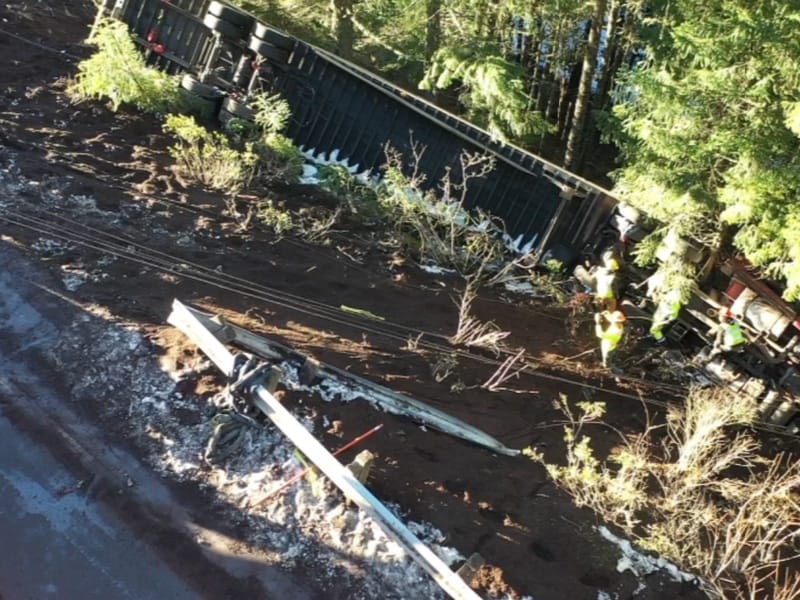
On a very cold November morning, we got the call about an Oakridge semi recovery that had gone bad in a hurry. The driver came around a curve on Highway 58, hit black ice, slid through the guardrail, and dropped down the embankment into the trees. By the time our towing team reached it, the trailer sat crooked on the hillside and looked ready to slip even farther down the mountain.
The truck had been there for nearly a week before we could bring it out. Operators spent about 18 hours over two days unloading pet supplies from the trailer just to make the recovery possible. Ten hours on Friday. Eight more on Saturday. If we had tried to pull the load out with all that cargo still inside, the trailer could have rolled or torn apart before we ever got it close to the road. That’s why we needed a little prep work before starting the heavy lifting.
Four Hours of Road Closure Gave Us a Chance to Work
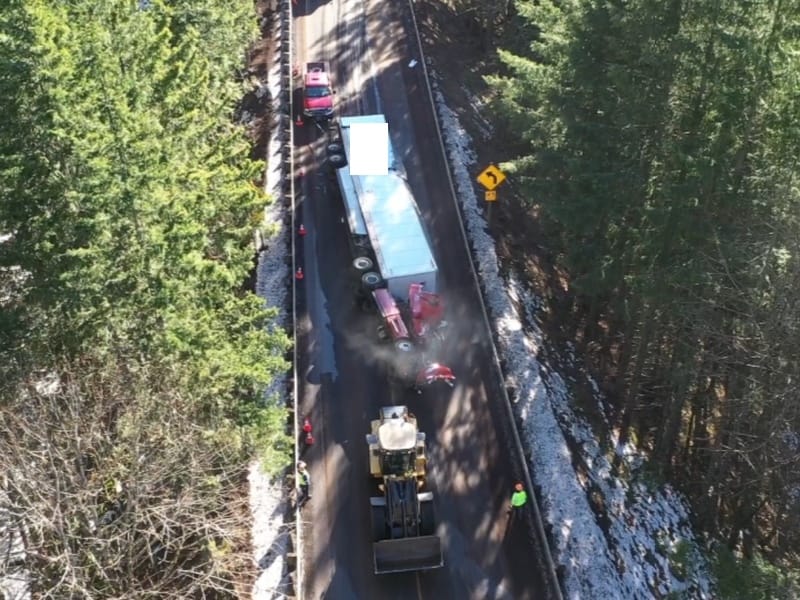
Most of the trouble on a mountain recovery comes from traffic. Highway 58 never stays quiet for long. Now that’s especially true the week before Thanksgiving. Cars and trucks kept moving past the scene just a few feet from where we needed to position our wreckers. But we needed space to maneuver. Not just space, we needed a safe operating environment to neither endanger our crew, nor the drivers passing by the scene.
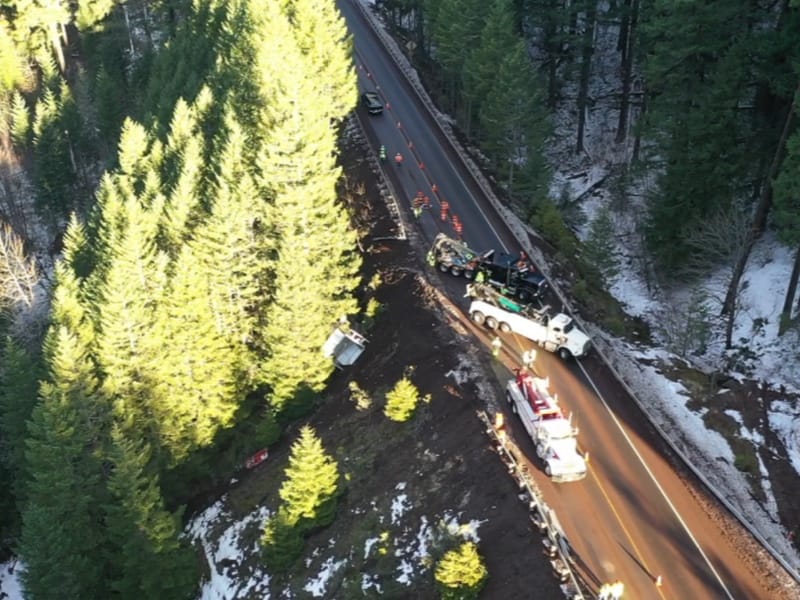
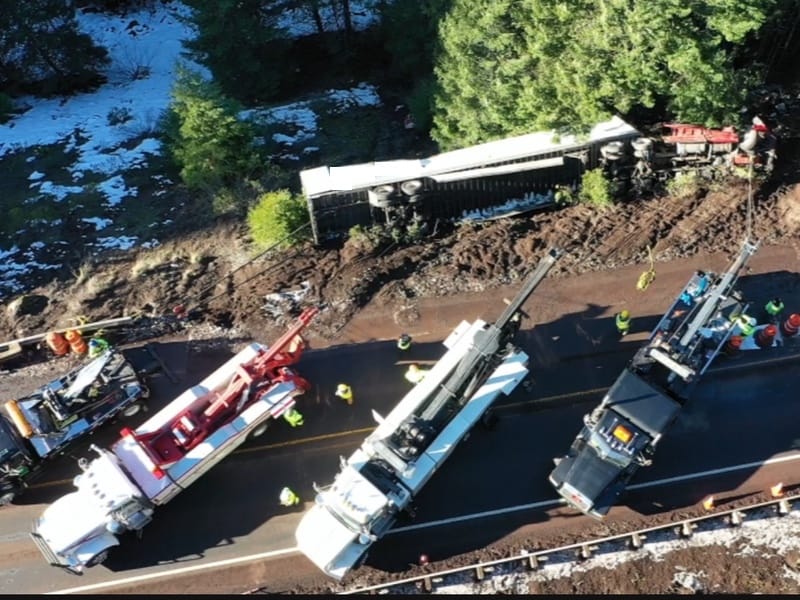
We originally asked the Oregon Department of Transportation (ODOT) for a 90-minute closure. After several conversations, they arranged a full four-hour shutdown of the highway! Needless to say, we were grateful for that extra time. It changed the whole job. We now had ample room to set four heavy trucks at the angle we needed instead of rushing the work while traffic pushed by us.
Why Four Trucks Were Necessary
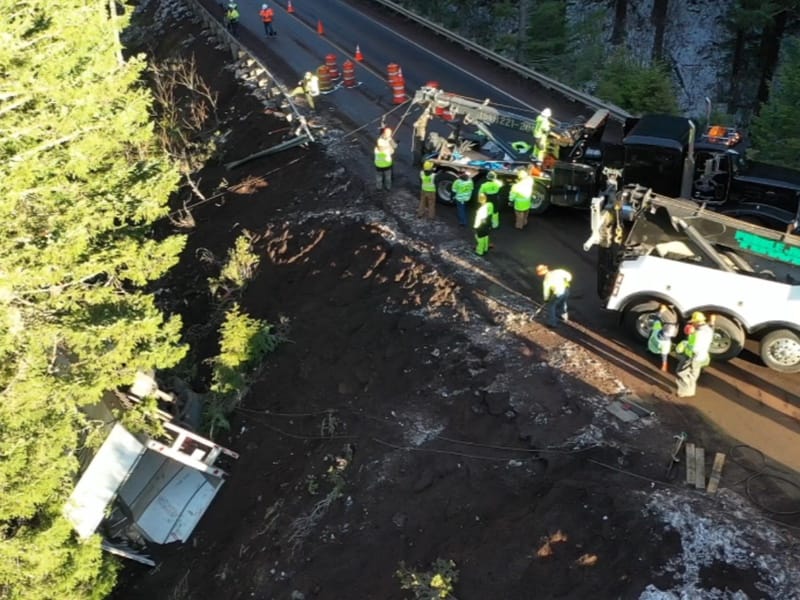
We could not line the trucks up straight because of the slope and the narrow shoulder. Each truck had to sit at a different angle to hold part of the load. We ran a line to every axle and added another line to the trailer. Once the pull started, every line had to move at the same speed.
Keeping the Semi From Sliding Deeper
The trailer had stopped on a steep embankment surrounded by trees and loose dirt. It was sitting in a shallow ravine on the hillside, and one wrong move could have sent it farther down. If that had happened, we probably would have needed another full day and more equipment to reach it.
Teamwork Made this (Towing) Dream Work
For this Oakridge semi recovery, we worked alongside another local towing company and had about 14 people on scene. Some were rigging lines, some were unloading cargo, and others watched the cables and traffic. The hardest part was finding enough room to put every truck in the right place without taking up the entire highway.
We Drew the Whole Recovery Out Before the First Cable Moved
Before the road closure happened, Michael Clement, owner of Puddle Jumper, walked several executives from the ODOT walked through this Oakridge semi recovery. He explained why we needed the highway closed and why four trucks had to sit at different angles on the shoulder. Michael said, “I used my WreckMaster 89 Rotator training to mathematically draw the whole towing process out for them.”
The plan was simple on paper. First, pull the semi up onto the shoulder while it stayed on its side. Then drag it to a wider spot farther up the road and roll it back onto its wheels. During the Oakridge semi recovery, we used blocks and rigging through the frame and axles so the truck stayed together as one unit instead of stretching apart during the pull.
The Order of the Pull
- Secure the trailer and tractor with separate lines.
- Bring the wreck up the hill in the same direction it slid down.
- Move it to the wider turnout.
- Roll it back onto the tires and tow it off the mountain.
Cold Weather Changed Everything
The first days we worked the scene, temperatures were around 12 degrees. Cables got stiff, the ground stayed frozen, and every patch of shade still held ice. By Tuesday morning the weather finally cleared up, which helped the Oakridge semi recovery move faster and kept the hillside from breaking apart under the trucks.
How Puddle Jumper Handled This Oakridge Semi Recovery
We see this kind of call every winter between Oakridge and Willamette Pass. One storm, one patch of black ice, and a semi ends up over the side of Highway 58. This Oakridge semi recovery worked because we had time to plan it, a road closure from ODOT, and enough room to get four trucks on the mountain before the trailer slid any farther. But everything went well. We were glad to count on our training and the support of ODOT as well as our amazing colleagues from the other towing company. KVAL 13 was on site to cover the story. Read their full news segment here: LINK .
All pictures courtesy of KVAL 12 / ODOT.
FAQs
What happens if a semi slides below the road but does not roll over?
A semi can still be difficult to recover if it is sitting on a slope. Tow crews usually have to secure it first so it does not slide farther.
How long does a mountain recovery usually take?
Some recoveries take a few hours. Others can take several days if the cargo needs to come out first.
Why would tow crews unload the trailer before pulling it out?
Removing the cargo makes the trailer lighter and more stable. It also lowers the chance of the trailer breaking apart during the pull.
Can the highway stay open during a heavy recovery?
Sometimes one lane stays open. On narrow mountain roads, crews often need a full closure to position the trucks.
What is a rotator truck used for?
A rotator truck lifts and pulls heavy wrecks from difficult spots. It helps when there is not enough room to park directly beside the vehicle.
How do tow crews keep a wrecked trailer from coming apart?
They use chains, straps, and rigging through the frame and axles. That keeps the trailer moving as one piece.